
A software engineer reviewing an architecture diagram on a whiteboard with boxes and arrows representing system design. AI-generated editorial image.
If you are building an MVP, the question is rarely “What architecture is most impressive?” The real question is “What architecture helps the team ship a reliable first release without creating avoidable maintenance debt?” For many startups and product teams, that means starting with a monolith or another simpler system shape unless there is a clear, practical reason to split services early.
This article focuses on a concrete decision: monolith vs microservices for MVPs. The goal is not to make one approach sound universally better. It is to help you compare trade-offs, identify the signals that matter, and verify whether your choice supports fast delivery, debugging, testing, maintainability, accessibility, performance and future growth.
Start with the simplest architecture that fits the product
A monolith keeps the core application in one codebase and usually one deployment unit. That does not mean “bad architecture.” It often means fewer moving parts, simpler local development, and a shorter path from idea to usable product. For an MVP, those traits can be valuable because they let the team focus on validation instead of platform complexity.
Microservices split the system into separate services that communicate over the network. That can help when different parts of the product need independent scaling, clear boundaries, or separate release cycles. But it also adds operational overhead: service discovery, distributed debugging, network failure handling, deployment coordination, and more decisions around data ownership.
For an early product, the practical rule is simple: choose the architecture that makes the next set of features easiest to build correctly, then keep the design open enough to evolve later.
Compare the trade-offs before you split the system
Here is a practical comparison you can use during planning:
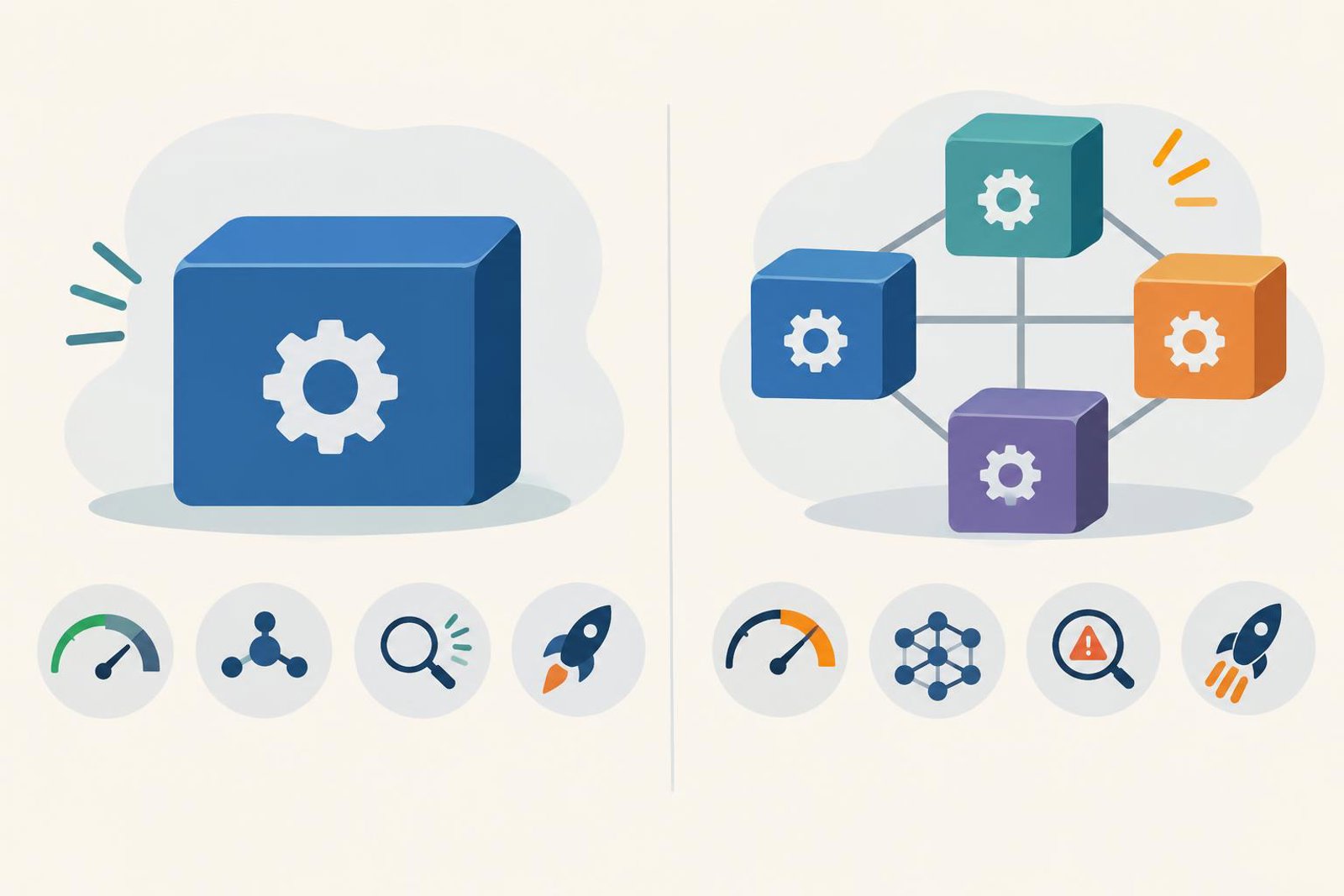
| Concern | Monolith | Microservices |
|---|---|---|
| Delivery speed | Usually faster to start because everything lives together | Often slower at first because coordination and infrastructure increase |
| Debugging | Usually easier because calls stay inside one process or one codebase | Harder because failures cross service boundaries |
| Testing | Integration tests are often simpler to write and run | Requires more contract and integration coverage across services |
| Maintainability | Can stay maintainable if boundaries are clear | Can improve modularity, but only if service boundaries are well chosen |
| Operational overhead | Lower | Higher |
The key trade-off is not “simple versus modern.” It is coordination cost versus isolation benefit. Microservices are useful when isolation solves a real problem. If there is no real problem yet, they can create one.
Use product and team signals to decide
You do not need a perfect prediction of the future. You need enough evidence to make a sensible first choice. Ask these questions:

- Does the MVP need multiple independently deployed parts right away?
- Are there clearly different domains that are already stable enough to separate?
- Will multiple teams work in parallel on different subsystems?
- Is there a strong operational need for separate scaling or failure isolation?
- Can the team confidently support the extra testing and deployment complexity?
If the answer to most of these is no, a monolith is often the safer choice for the first release. If the answer to several is yes and the boundaries are truly clear, splitting early may be justified.
A common mistake is to treat “microservices” as a synonym for “scalable.” Scalability depends on the bottlenecks in the product, the data model, the traffic pattern, and the operational setup. A monolith can scale further than many people expect, especially when the team keeps it modular and well tested.
Design the monolith so it can evolve
Choosing a monolith for an MVP does not mean building a tangled codebase. Good monolithic design is about creating internal boundaries that are easy to understand. You want the freedom to extract a service later if a boundary becomes real, not imagined.
Useful practices include:
- Organize code by domain or feature rather than by technical layer only.
- Keep data access, business rules and interface code separated where practical.
- Use clear module boundaries and avoid circular dependencies.
- Define integration points explicitly even inside one codebase.
- Document which parts of the system own which data and rules.
These practices help with maintainability whether you later split services or not. They also make code reviews, onboarding and debugging easier for the team.
Know what changes when you move to microservices
If the product outgrows a monolith, move for a reason—not because the diagram looks cleaner. Typical reasons include a hotspot that needs independent scaling, a domain boundary that is already stable, or a team structure that benefits from separate deployment cycles.
Before extracting a service, verify three things:
- Ownership is clear. One service should clearly own a business capability and its data boundaries.
- Communication is simple. The system should not require excessive synchronous calls for every user action.
- Failure is acceptable. You can explain what happens if the new service is slow or unavailable.
Extraction without these checks often produces distributed coupling. That creates more work for debugging, testing and incident response than the team expected.
For example, a hypothetical MVP might start as a single application with user accounts, payments and notifications. If notifications begin to have different throughput or reliability needs, it may make sense to separate them later. But if the team cannot define the boundary, the data flow and the failure mode, it is too early to split.
How to verify that your architecture choice is working
Do not wait for a production incident to judge the design. Use concrete verification steps during development and after each release:
- Run the full local setup from scratch on a clean machine or container.
- Measure how long it takes a developer to make a small change and test it end to end.
- Check whether common bugs are easy to trace through logs and code paths.
- Review whether the test suite covers the boundaries that matter most.
- Confirm that deployment steps match the team’s ability to operate the system.
If the architecture is helping, the team should see fewer accidental dependencies, fewer unclear responsibilities and less time lost to setup or debugging. If not, the design may be too fragmented—or too loosely organized.
Practical test: if a new engineer can understand the core flow, run the app and make a safe change without needing a long explanation, the architecture is probably working for the current stage.
Checklist for the MVP architecture decision
- Define the first release goal in one sentence.
- List the main product capabilities and their dependencies.
- Identify the simplest deployment shape that supports those capabilities.
- Separate domains in code before you separate them into services.
- Choose microservices only when isolation solves a real problem.
- Plan how you will test, observe and operate the system after release.
- Revisit the architecture after real usage reveals bottlenecks.
The right answer for most MVPs is not “always monolith” or “always microservices.” It is a deliberate choice based on product risk, team size, operational capacity and the need to learn quickly. Start simple, build clean boundaries, and split only when the evidence is strong.
For more practical engineering guidance, see the tech blog and the related article on choosing the right architecture for your MVP.
Next step: review your current system or planned MVP against the checklist above, then choose the simplest architecture that still supports reliable delivery.